Ace (Paracetamol/Acetaminophen): An Analgesic and Antipyretic Medication
Ace is a widely used non-opioid analgesic and antipyretic (fever-reducing) medication. Its primary indications include relieving pain and reducing fever across various conditions.
How Ace Works (Pharmacology)
Paracetamol (Acetaminophen) primarily acts in the Central Nervous System (CNS). Its mechanism is believed to involve increasing the pain threshold by inhibiting cyclooxygenase (COX) enzymes, including COX-1, COX-2, and a proposed COX-3, which are involved in prostaglandin (PG) synthesis. Prostaglandins are chemicals that contribute to pain and inflammation.
Unlike NSAIDs (Nonsteroidal Anti-inflammatory Drugs), Paracetamol does not significantly inhibit COX in peripheral tissues, which explains its weak anti-inflammatory activity outside the CNS. Its ability to inhibit COX is indirect and can be affected by the presence of peroxides.
The antipyretic (fever-reducing) properties of Paracetamol are likely due to its direct effects on the hypothalamic heat-regulating center, leading to peripheral vasodilation and sweating, which helps dissipate heat from the body.
Key Indications & Benefits
Ace is indicated for the relief of:
- Fever
- Common cold and influenza symptoms
- Headache
- Toothache
- Earache
- Bodyache
- Myalgia (muscle pain)
- Neuralgia (nerve pain)
- Dysmenorrhoea (menstrual pain)
- Sprains
- Colic pain
- Back pain
- Post-operative pain
- Postpartum pain
- Inflammatory pain
- Post-vaccination pain in children
- Rheumatic & osteoarthritic pain and stiffness of joints.
Dosage & Administration
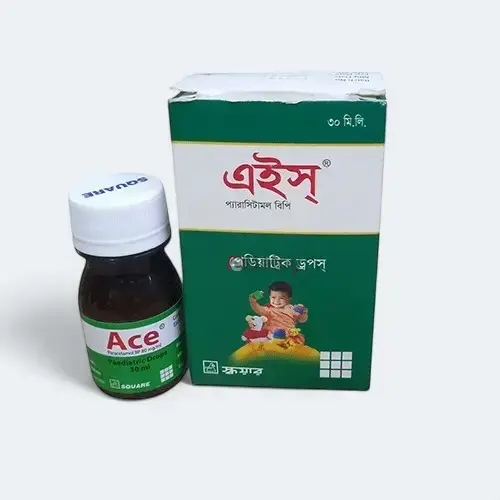
Ace is available in various forms: Tablet, Extended Release Tablet, Syrup/Suspension, Suppository, Paediatric Drop, and IV Infusion. Always consult a registered physician for medication use.
General Dosing Principles:
- Do not exceed the stated dose.
- Do not take other Paracetamol-containing products concurrently.
Specific Dosage Guidelines:
- Tablet (Standard):
- Adult: 1-2 tablets every 4-6 hours (maximum 4 gm/8 tablets daily).
- Children (6-12 years): ½ to 1 tablet 3-4 times daily (for long-term, do not exceed 2.6 gm/day).
- Extended Release Tablet:
- Adults & Children over 12 years: Two tablets, swallowed whole, every 6-8 hours (maximum 6 tablets in 24 hours). Must not be crushed.
- Syrup/Suspension:
- Children under 3 months: 10 mg/kg body weight (reduce to 5 mg/kg if jaundiced) 3-4 times daily.
- 3 months to below 1 year: ½ to 1 teaspoonful 3-4 times daily.
- 1-5 years: 1-2 teaspoonful 3-4 times daily.
- 6-12 years: 2-4 teaspoonful 3-4 times daily.
- Adults: 4-8 teaspoonful 3-4 times daily.
- Suppository:
- Children 3-12 months: 60-120 mg, 4 times daily.
- Children 1-5 years: 125-250 mg 4 times daily.
- Children 6-12 years: 250-500 mg 4 times daily.
- Adults & children over 12 years: 0.5-1 gm 4 times daily.
- Paediatric Drop: (Do not exceed more than 5 doses daily for a maximum of 5 days)
- Upto 3 months: 0.5 ml (40 mg)
- 4 to 11 months: 1.0 ml (80 mg)
- 7 months to 2 years: 1.5 ml (120 mg).
- Tablet with Actizorb Technology: (Fast-acting)
- Adults and children (aged 12 years and over): 1 to 2 Tablets every 4-6 hours as needed (maximum 8 caplets in 24 hours).
- Children (7 to 11 years): ½-1 Tablet every 4-6 hours as needed (maximum 4 caplets in 24 hours). Not recommended for children under 7 years.
- IV Infusion:
- Adults and adolescents ≥50 kg: 1000 mg every 6 hours OR 650 mg every 4 hours.
- Maximum single dose: 1000 mg.
- Minimum dosing interval: 4 hours.
- Maximum daily dose: 4000 mg.
- Adults and adolescents $<$50 kg: 15 mg/kg every 6 hours OR 12.5 mg/kg every 4 hours.
- Maximum single dose: 15 mg/kg.
- Minimum dosing interval: 4 hours.
- Maximum daily dose: 75 mg/kg per day.
- Children $>$2 to 12 years of age: 15 mg/kg every 6 hours OR 12.5 mg/kg every 4 hours.
- Maximum single dose: 15 mg/kg.
- Minimum dosing interval: 4 hours.
- Maximum daily dose: 75 mg/kg per day.
Important Considerations & Warnings
It is crucial to discuss your full medical history with your doctor before taking Ace.
Contraindications:
- Known hypersensitivity to Paracetamol.
Side Effects:
- Side effects are usually mild.
- Haematological reactions (rarely reported): thrombocytopenia (low platelets), leucopenia (low white blood cells), pancytopenia (low all blood cells), neutropenia (low neutrophils), and agranulocytosis (severe low white blood cells).
- Occasionally: Pancreatitis, skin rashes, and other allergic reactions.
Pregnancy & Lactation:
- Pregnancy: Epidemiological studies show no ill effects from Paracetamol at recommended dosages during pregnancy, but patients should always follow their doctor's advice.
- Lactation: Paracetamol is excreted in breast milk in clinically insignificant amounts. Available data do not contraindicate breastfeeding.
Precautions & Warnings:
- Hepatic & Renal Impairment:
- Care is advised in patients with severe renal or severe hepatic impairment.
- The hazard of overdose is greater in those with non-cirrhotic alcoholic liver disease.
- Contraindicated in patients with severe hepatic impairment or severe active liver disease.
- Use with caution in patients with hepatic impairment or active liver disease, alcoholism, chronic malnutrition, severe hypovolemia (e.g., due to dehydration or blood loss), or severe renal impairment (creatinine clearance $<$30 ml/min). A reduced total daily dose may be warranted in these cases.
- Overdose Risk:
- Do not exceed the stated dose.
- Patients should be advised not to take other Ace-containing products concurrently.
- Administration of doses higher than recommended may result in hepatic injury, including severe hepatotoxicity and death.
- Allergic Reactions: Infrequent reports of life-threatening anaphylaxis requiring emergency medical attention. Discontinue Ace IV immediately if symptoms associated with allergy or hypersensitivity occur. Do not use Ace IV in patients with Ace allergy.
- Ace should only be used by the patient for whom it is prescribed when clearly necessary.
Drug Interactions:
- Diminished metabolism of Ace (with large doses): Patients taking barbiturates, tricyclic antidepressants, and alcohol.
- Increased hepatotoxicity of Ace overdosage: Alcohol.
- Reduced therapeutic Ace levels (due to increased metabolism): Chronic ingestion of anticonvulsants or oral steroid contraceptives (induce liver enzymes).
Use in Special Populations:
- Pediatric Use (IV Infusion): Safety and effectiveness for acute pain and fever in pediatric patients 2 years and older is supported by adult studies.
- Geriatric Use: No overall differences in safety or effectiveness observed between elderly and younger subjects; greater sensitivity of some older individuals cannot be ruled out.
Overdose Effects
Liver damage is possible: In adults who have taken 10 g or more of Ace. Ingestion of 5 g or more may lead to liver damage if risk factors are present (e.g., long-term treatment with liver enzyme-inducing drugs like Carbamazepine, Phenobarbitone, Phenytoin, Primidone, Rifampicin, St John's Wort; regular excessive alcohol consumption; or glutathione depletion due to eating disorders, cystic fibrosis, HIV infection, starvation, cachexia).
Symptoms of Overdose (first 24 hours): Pallor, nausea, vomiting, anorexia, and abdominal pain.
- Liver damage: May become apparent 12-48 hours after ingestion.
- Severe poisoning: Can progress to encephalopathy, hemorrhage, hypoglycemia, cerebral edema, and death.
- Acute renal failure: With acute tubular necrosis (suggested by loin pain, hematuria, proteinuria) may develop even without severe liver damage.
- Other: Cardiac arrhythmias and pancreatitis have been reported.
Immediate treatment is essential for Ace overdose.
- Activated charcoal: Consider if overdose taken within 1 hour.
- Plasma Ace concentration: Measure at 4 hours or later after ingestion (earlier concentrations are unreliable).
- N-acetylcysteine (NAC): Can be used up to 24 hours after ingestion. Maximum protective effect is within 8 hours. Effectiveness declines sharply after this time. Administer intravenously as per dosage schedule.
- Oral Methionine: A suitable alternative for remote areas, outside hospital, if vomiting is not a problem.
- Management of severe hepatic dysfunction (beyond 24 hours): Should be discussed with a poison control center or liver unit.
Storage Conditions
Keep in a dry place away from light and heat. Keep out of the reach of children.



Comment