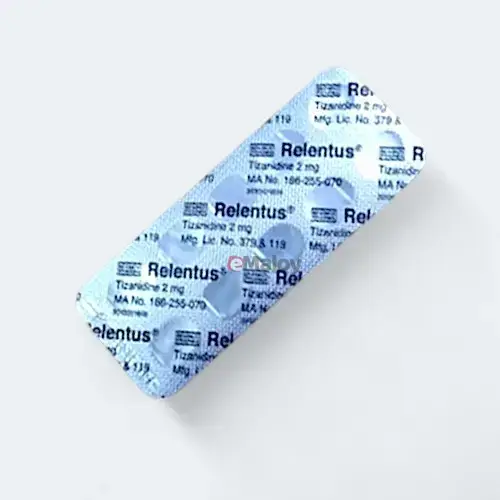
Relentus (Tizanidine): A Centrally Acting Skeletal Muscle Relaxant
Relentus contains Tizanidine, a centrally acting skeletal muscle relaxant. It is indicated for the treatment of painful muscle spasms associated with spine disorders or following surgery, and for spasticity due to various neurological disorders. It belongs to the therapeutic class of Centrally acting Skeletal Muscle Relaxants.
How Relentus Works (Pharmacology)
Tizanidine's primary site of action is the spinal cord:
- Stimulates Presynaptic Alpha-2 Receptors: Evidence suggests it works by stimulating presynaptic alpha-2 adrenergic receptors.
- Inhibits Excitatory Amino Acid Release: This stimulation inhibits the release of excitatory amino acids that activate N-methyl-D-aspartate (NMDA) receptors.
- Reduces Muscle Tone: This inhibition reduces polysynaptic signal transmission at the spinal interneuron level, which is responsible for excessive muscle tone, thereby reducing overall muscle tone.
- Central Analgesic Effect: In addition to its muscle-relaxant properties, tizanidine also exerts a moderate central analgesic effect.
- Effectiveness: It is effective in both acute painful muscle spasms and chronic spasticity of spinal and cerebral origin, reducing resistance to passive movements, alleviating spasms and clonus, and potentially improving voluntary strength. Its activity and side effects are related to plasma concentrations.
Key Indications & Benefits
Relentus is indicated for:
- Treatment of painful muscle spasms:
- Associated with static and functional disorders of the spine (cervical and lumbar syndromes).
- Following surgery (e.g., for herniated intervertebral disc or osteoarthritis of the hip).
- Treatment of spasticity due to neurological disorders:
- Multiple sclerosis, chronic myelopathy, degenerative spinal cord diseases, cerebrovascular accidents, and cerebral palsy.
Dosage & Administration
Tizanidine has a narrow therapeutic index, requiring individualized dose adjustment. A low starting dose is recommended to minimize adverse effects. Always consult a registered physician for specific dosage instructions.
Relief of Painful Muscle Spasms:
- Usual dose: 2 to 4 mg three times daily (in tablet form).
- In severe cases, an extra dose of 2 or 4 mg may be taken, preferably at night to minimize sedation.
Spasticity due to Neurological Disorders:
- Initial daily dose: Should not exceed 6 mg, given in 3 divided doses.
- Increases: May be increased stepwise at half-weekly or weekly intervals by 2 to 4 mg.
- Optimum therapeutic response: Generally achieved with a daily dose of between 12 and 24 mg, administered in 3 or 4 equally spaced doses.
- Maximum daily dose: 36 mg should not be exceeded.
Special Populations:
- Pediatric patients (below 18 years): Limited experience; use is not recommended.
- Geriatric patients (65 years or older): Limited experience; start treatment at the lowest dose and increase slowly according to tolerability and efficacy.
- Renal impairment (creatinine clearance <25 mL/min): Start treatment at 2 mg once daily. Increase dosage slowly according to tolerability and efficacy. If more efficacy is needed, first increase the strength of the daily dose before increasing administration frequency.
- Hepatic impairment:
- Severe hepatic impairment: Contraindicated.
- Moderate hepatic impairment: Use with caution; start with the lowest dose and increase carefully based on tolerability. Liver function tests should be monitored regularly (see precautions).
Discontinuation of Treatment:
- If Tizanidine needs to be discontinued, the dosage should be slowly down-titrated, especially in patients on high doses for a prolonged period, to avoid or minimize the risk of rebound hypertension and tachycardia.
Important Considerations & Warnings
It is crucial to discuss your full medical history with your doctor before taking Relentus.
Contraindications:
- Known hypersensitivity to tizanidine or any excipients.
- Severely impaired hepatic function.
- Concomitant use with strong inhibitors of CYP1A2 such as fluvoxamine or ciprofloxacin.
Side Effects:
- With low doses (for painful muscle spasms): Somnolence (drowsiness), fatigue, dizziness, dry mouth, blood pressure decrease, nausea, gastrointestinal disorder, and transaminase increase. These are usually mild and transient.
- With higher doses (for spasticity): The adverse reactions reported with low doses are more frequent and pronounced, but seldom severe enough to require discontinuation.
- Additional adverse reactions at higher doses: Hypotension, bradycardia, muscular weakness, insomnia, sleep disorder, hallucination, and hepatitis.
- Specific side effect frequencies:
- Very Common: Somnolence, dizziness, muscular weakness, fatigue, dry mouth, gastrointestinal disorder.
- Common: Insomnia, sleep disorder, hypotension, nausea, blood pressure decreased, transaminases increased.
- Uncommon: Bradycardia.
Pregnancy & Lactation:
- Pregnancy: Limited experience in pregnant women. Should not be used during pregnancy unless the benefit clearly outweighs the risk. Animal studies show potential for harm to the fetus (increased gestation duration, prenatal/postnatal pup loss, developmental retardation at higher doses where maternal toxicity occurred).
- Lactation: Small amounts are excreted in rat milk. Since no human data are available, Tizanidine should not be given to women who are breast-feeding.
- Females of reproductive potential: Recommended to have a pregnancy test prior to starting treatment and use effective contraception (less than 1% pregnancy rates) during treatment and for 1 day after stopping. Animal studies indicate potential harm to the developing fetus.
- Fertility: Reduced in male rats at 30 mg/kg/day and female rats at 10 mg/kg/day (doses significantly higher than human max recommended dose, and associated with maternal toxicity).
Precautions & Warnings:
- CYP Inhibitors: Concomitant use with moderate CYP1A2 inhibitors is not recommended. Caution with drugs known to increase the QT interval.
- Hypotension: May occur during treatment and due to interactions (CYP1A2 inhibitors, antihypertensives). Severe manifestations like loss of consciousness and circulatory collapse have been observed.
- Withdrawal Syndrome: Rebound hypertension and tachycardia have been observed after sudden withdrawal, especially with chronic/high doses or concomitant antihypertensives. In extreme cases, this can lead to cerebrovascular accident. Relentus should not be stopped abruptly, but rather gradually down-titrated.
- Hepatic Dysfunction: Liver function tests should be monitored monthly for the first four months in patients receiving doses of 12 mg/day or higher, and in those with clinical symptoms of hepatic dysfunction (e.g., unexplained nausea, anorexia, tiredness). Discontinue if SGPT or SGOT levels are persistently above three times the upper limit of normal.
- Renal Impairment: Systemic exposure can increase significantly. Start treatment at 2 mg once daily.
- Hypersensitivity Reactions: Anaphylaxis, angioedema, dermatitis, rash, urticaria, pruritus, erythema have been reported. Careful observation for 1-2 days after the first dose is recommended. Discontinue immediately if anaphylaxis or angioedema with shock/difficulty breathing occurs and institute appropriate medical treatment.
- Driving and Using Machines: Patients experiencing somnolence, dizziness, or hypotension should refrain from activities requiring high alertness (e.g., driving, operating machinery).
Drug Interactions:
- Strong CYP1A2 Inhibitors (e.g., fluvoxamine, ciprofloxacin): Contraindicated. Concomitant use significantly increases tizanidine plasma levels (e.g., 33-fold with fluvoxamine, 10-fold with ciprofloxacin), leading to profound and prolonged hypotension, somnolence, dizziness, decreased psychomotor performance, and potentially QT(c) prolongation.
- Other CYP1A2 Inhibitors (e.g., amiodarone, mexiletine, propafenone, cimetidine, fluoroquinolones like enoxacin/pefloxacin/norfloxacin, rofecoxib, oral contraceptives, ticlopidine): Not recommended for concomitant use due to increased tizanidine plasma levels.
- Drugs known to prolong QT interval (e.g., cisapride, amitriptyline, azithromycin): Caution should be exercised.
- Antihypertensives (including diuretics): May cause hypotension and bradycardia. Abrupt discontinuation of Relentus when used with antihypertensives can cause rebound hypertension and tachycardia, potentially leading to cerebrovascular accident.
- Rifampicin (CYP1A2 Inducer): Decreases tizanidine concentrations by 50%. Reduced therapeutic effects of Relentus may occur. Long-term co-administration should be avoided; if necessary, a careful dose adjustment (increase) may be required.
- Cigarette Smoke: Heavy smokers (>10 cigarettes/day) have about 30% decreased tizanidine exposure. Long-term therapy in heavy smokers may require higher doses.
- Alcohol: Consumption should be minimized or avoided, as it may increase the potential for adverse events (sedation, hypotension) and enhance the CNS depressant effects of tizanidine.
- Sedatives, Hypnotics (e.g., benzodiazepine or baclofen), Antihistamines: May enhance the sedative action of tizanidine.
- Other Alpha-2 Adrenergic Agonists (e.g., clonidine): Should be avoided due to potential additive hypotensive effect.
Overdose Effects
- Reported features of overdosage: Confusion, drowsiness, headache, bradycardia, respiratory depression, nausea, vomiting, hypotension, QT(c) prolongation, dizziness, somnolence, miosis, restlessness, respiratory distress, coma. Recovery has been uneventful in reported cases, even with high doses (e.g., 400 mg).
- Management:
- Eliminate ingested drug by repeated administration of high doses of activated charcoal.
- Forced diuresis is expected to accelerate elimination.
- Further treatment should be symptomatic and supportive.
Storage Conditions
Store in a dry place below 30°C. Relentus must be kept out of the reach and sight of children.



Comment