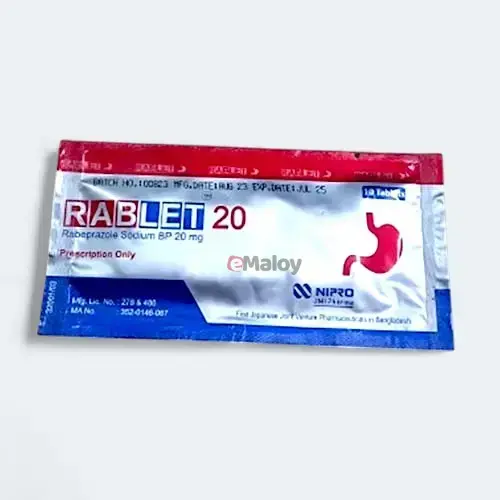
Rablet (Rabeprazole Sodium): A Proton Pump Inhibitor (PPI)
Rablet contains Rabeprazole Sodium, a proton pump inhibitor (PPI) that effectively suppresses gastric acid secretion. It is indicated for the treatment of various acid-related conditions, including ulcers, GERD, and Zollinger-Ellison Syndrome, and in H. pylori eradication regimens. It belongs to the therapeutic class of Proton Pump Inhibitors.
How Rablet Works (Pharmacology)
Rabeprazole works by:
- Inhibiting the Proton Pump: It directly inhibits the gastric H+/K+-ATPase, commonly known as the "proton pump," located at the secretory surface of the gastric parietal cells in the stomach lining.
- Reducing Gastric Acid Secretion: This enzyme is responsible for the final step of acid production and secretion into the stomach. By blocking this pump, Rabeprazole profoundly and persistently reduces the amount of gastric acid produced, regardless of the stimulus.
Key Indications & Benefits
Rablet is indicated for the treatment of:
- Active duodenal ulcer.
- Active benign gastric ulcer.
- Symptomatic erosive or ulcerative gastro-esophageal reflux disease (GERD).
- Gastro-esophageal Reflux Disease Long-term Management (GERD Maintenance).
- Symptomatic treatment of moderate to very severe gastro-esophageal reflux disease (symptomatic GERD).
- Zollinger-Ellison Syndrome.
- In combination with appropriate antibacterial therapeutic regimens for the eradication of Helicobacter pylori in patients with peptic ulcer disease.
Dosage & Administration
Rablet tablets should be swallowed whole and are generally taken in the morning before eating, though food intake doesn't affect its activity. Always consult a registered physician for specific dosage instructions.
Active Duodenal Ulcer and Active Benign Gastric Ulcer:
- Recommended oral dose: 20 mg once daily in the morning.
- Most duodenal ulcers heal within 4 weeks (some may need an additional 4 weeks).
- Most benign gastric ulcers heal within 6 weeks (some may need an additional 6 weeks).
Erosive or Ulcerative Gastro-Esophageal Reflux Disease (GERD):
- Recommended oral dose: 20 mg once daily for 4 to 8 weeks.
Gastro-Esophageal Reflux Disease Long-term Management (GERD Maintenance):
- Maintenance dose: 10 mg or 20 mg once daily, depending on patient response.
Symptomatic treatment of moderate to very severe Gastro-Esophageal Reflux Disease (symptomatic GERD):
- Dose: 10 mg once daily in patients without esophagitis.
- If symptom control is not achieved within four weeks, further investigation is needed.
- Once symptoms resolve, subsequent control can be achieved with an on-demand regimen of 10 mg once daily when needed.
Treatment of GERD in Pediatric Patients 1 to 11 years of age:
- Less than 15 kg: 5 mg once daily for 12 weeks, with an option to increase to 10 mg if response is inadequate.
- 15 kg or more: 10 mg once daily for 12 weeks.
Zollinger-Ellison Syndrome:
- Recommended adult starting dose: 60 mg once a day.
- Titration: Dose may be titrated upwards to 120 mg/day based on individual patient needs.
- Single daily doses up to 100 mg/day may be given.
- 120 mg dose may require divided doses (e.g., 60 mg twice daily).
- Treatment should continue as long as clinically indicated.
Eradication of H. pylori (7-day combination regimen):
- Rabeprazole sodium 20 mg twice daily.
- Clarithromycin 500 mg twice daily.
- Amoxicillin 1g twice daily.
Important Considerations & Warnings
It is crucial to discuss your full medical history with your doctor before taking Rablet.
Contraindications:
- Hypersensitivity to Rabeprazole or any of its excipients.
- Pregnancy and during breastfeeding.
Side Effects:
- Generally well-tolerated.
- Common: Headache, diarrhea, abdominal pain, vomiting, constipation, dry mouth, increased or decreased appetite, muscle pain, drowsiness, dizziness.
- Long-term use/High Doses (Warnings):
- Bone fractures: Modestly increased risk of hip, wrist, and spine fractures, predominantly in the elderly or those with other risk factors. Patients at risk should ensure adequate Vitamin D and calcium intake.
- Hypomagnesemia: Severe low magnesium levels reported in some patients on prolonged PPI treatment (at least 3 months, often a year), potentially leading to fatigue, tetany, delirium, convulsions, dizziness, and ventricular arrhythmia. Magnesium levels may need monitoring.
- Vitamin B12 absorption: May reduce absorption of vitamin B12 due to acid suppression, especially in patients with reduced body stores or risk factors for deficiency on long-term therapy.
- Gastrointestinal infections: May increase the risk of infections such as Salmonella, Campylobacter, and Clostridium difficile.
- Blood dyscrasias (thrombocytopenia and neutropenia) and hepatic enzyme abnormalities have been reported post-marketing, usually resolving upon discontinuation.
- Subacute cutaneous lupus erythematosus (SCLE): Very infrequent cases reported. If lesions occur, especially in sun-exposed areas, and with arthralgia, stop Rablet and seek medical help.
Pregnancy & Lactation:
- US FDA pregnancy category 'C'. Animal studies showed no impaired fertility or harm, but no adequate and well-controlled studies in pregnant women. Contraindicated in pregnancy.
- Lactation: Rabeprazole is likely to be excreted in human milk. Contraindicated during breastfeeding. A decision should be made whether to discontinue nursing or the drug, considering the importance of the drug to the mother.
Precautions & Warnings:
- Exclusion of Malignancy: Symptomatic response to Rablet does not rule out the presence of gastric or esophageal malignancy. Malignancy should be excluded before starting treatment.
- Long-term Treatment: Patients on long-term treatment (especially >1 year) should be kept under regular surveillance.
- Tablet Administration: Rablet gastro-resistant tablets should not be chewed or crushed, but swallowed whole.
- Severe Hepatic Dysfunction: Use caution when first initiating treatment in patients with severe hepatic dysfunction, as there are limited clinical data.
- Co-administration with Atazanavir:Not recommended due to pH-dependent absorption of atazanavir.
- Interference with Laboratory Tests: May increase Chromogranin A (CgA) levels, interfering with neuroendocrine tumor investigations. Stop Rablet for at least 5 days before CgA measurements.
Drug Interactions:
- pH-dependent absorption drugs: May interact with compounds whose absorption is pH dependent. Co-administration with ketoconazole or itraconazole may significantly decrease their plasma levels, requiring monitoring or dosage adjustment.
- Atazanavir: Co-administration is not recommended.
- No interaction with liquid antacids observed.
Use in Special Populations
- Renal and Hepatic Impairment: No dosage adjustment is necessary for patients with renal or mild to moderate hepatic impairment. Caution advised for severe hepatic dysfunction.
- Pediatric Populations (under 1 year): Not recommended due to lack of data on safety and efficacy. Specific pediatric dosing is provided for ages 1-11 years for GERD.
Overdose Effects
- Maximum established exposure did not exceed 60 mg twice daily or 160 mg once daily.
- Effects are generally minimal, consistent with the known side effect profile, and reversible.
- No specific antidote is known.
- Not significantly dialyzable.
- Treatment should be symptomatic and supportive.
Storage Conditions
Keep below 30°C temperature, away from light & moisture. Keep out of the reach of children.



Comment