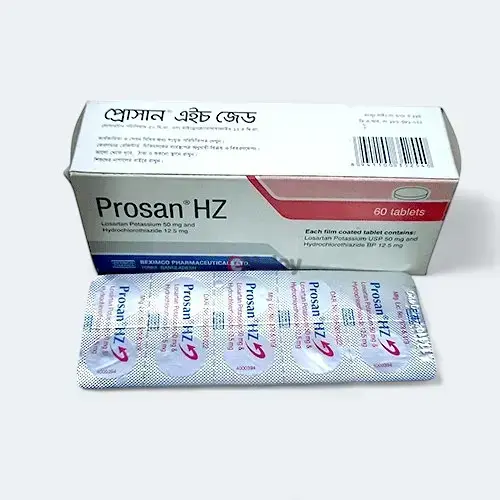
Prosan HZ (Losartan Potassium + Hydrochlorothiazide): Combined Antihypertensive Preparation
Prosan HZ is a combination medication containing Losartan Potassium, an angiotensin II receptor blocker (ARB), and Hydrochlorothiazide, a thiazide diuretic. It is indicated for the treatment of hypertension and to reduce the risk of stroke in patients with hypertension and left ventricular hypertrophy.
How Prosan HZ Works (Pharmacology)
This combination works through two complementary mechanisms:
- Losartan Potassium (Angiotensin II Receptor Blocker - ARB):
- Blocks AT1 Receptor: Losartan and its active metabolite selectively block the binding of angiotensin II to the AT1 receptor. Angiotensin II, formed by ACE, is a powerful vasoconstrictor and a key hormone in the renin-angiotensin system, contributing to hypertension and stimulating aldosterone secretion.
- Reduces Vasoconstriction and Aldosterone Secretion: By blocking AT1 receptors, Losartan reduces the vasoconstrictor effects of angiotensin II and its stimulation of aldosterone secretion.
- No ACE Inhibition: Neither Losartan nor its active metabolite inhibits ACE, meaning it doesn't affect bradykinin degradation, which is associated with the cough side effect seen with ACE inhibitors.
- Hydrochlorothiazide (Thiazide Diuretic):
- Increases Sodium and Chloride Excretion: Thiazides act on the renal tubules, directly increasing the excretion of sodium and chloride in roughly equivalent amounts.
- Reduces Plasma Volume: This diuretic action indirectly reduces plasma volume, leading to an increase in plasma renin activity, aldosterone secretion, and urinary potassium loss, with a decrease in serum potassium.
- Reversing Potassium Loss: Co-administration with an ARB like Losartan helps to counter the potassium loss typically associated with thiazide diuretics, as the renin-aldosterone link is mediated by angiotensin II.
The combination provides a more robust antihypertensive effect by targeting different pathways involved in blood pressure regulation.
Key Indications & Benefits
Prosan HZ is indicated for:
- Treatment of hypertension.
- Reducing the risk of stroke in patients with hypertension and left ventricular hypertrophy.
Dosage & Administration
Prosan HZ can be administered with or without food. It may also be administered with other antihypertensive agents. Always consult a registered physician for medication use.
Hypertension:
- Usual starting dose: One tablet of 50/12.5 mg once daily.
- For inadequate response: Dosage may be increased to 100/25 mg once daily.
- Switching from Losartan 100 mg monotherapy (if inadequate control): May be switched to 100/12.5 mg once daily.
- Hypertensive patients with left ventricular hypertrophy:
- Initial dose:50/12.5 mg.
- If additional BP reduction needed: May be increased to 100/12.5 mg, then 100/25 mg if required.
- Maximum dose:100/25 mg once daily.
- The antihypertensive effect is generally achieved within three weeks.
Severe Hypertension (Initial Treatment):
- Starting dose: One tablet of 50/12.5 mg once daily.
- For inadequate response after 2-4 weeks: Dosage may be increased to 100/25 mg once daily.
- Maximum dose: One tablet of 100/25 mg once daily.
Elderly Patients (up to 75 years):
- No initial dosage adjustment of 50/12.5 mg is necessary.
- However, 100/25 mg once daily should not be used as initial therapy in elderly patients.
Important Considerations & Warnings
It is crucial to discuss your full medical history with your doctor before taking Prosan HZ.
Contraindications:
- Patients who are hypersensitive to any component of this product.
- Patients with anuria (due to the Hydrochlorothiazide component).
- Patients with hypersensitivity to other sulfonamide-derived drugs (due to the Hydrochlorothiazide component).
Side Effects:
- Generally mild.
- Common: Dizziness (especially symptomatic hypotension in volume-depleted patients), fatigue, headache, gastro-intestinal disturbances (nausea, vomiting, diarrhea, constipation, abdominal pain), nasal congestion, cough, upper respiratory infection, cold or numb extremities, muscle weakness or cramps.
- Less common/Serious: Hyperkalemia (occurs occasionally), angioedema (reported with some ARBs), vertigo, angina, palpitation, edema, dyspnea, sleep disorders, malaise, urticaria, pruritus, rash.
- Rarely reported: Hepatitis, atrial fibrillation, cerebrovascular accident, syncope, paraesthesia, pancreatitis, anaphylaxis, depression, erectile dysfunction, anemia, thrombocytopenia, hyponatremia, arthralgia, myalgia, renal impairment, rhabdomyolysis, tinnitus, photosensitivity, vasculitis (including Henoch-Schonlein purpura).
Pregnancy & Lactation:
- Pregnancy Category D:Angiotensin-II receptor antagonists (Losartan) should be avoided in pregnancy unless absolutely essential. They can adversely affect fetal and neonatal blood pressure control and renal function; skull defects and oligohydramnios have also been reported.
- Lactation: Information on the use of angiotensin-II receptor antagonists in breastfeeding is limited. They are not recommended during breastfeeding, and alternative treatment options with better-established safety information during breastfeeding are available.
Precautions & Warnings:
- Hypersensitivity: Angioedema has been reported.
- Electrolyte Imbalance: Periodic determination of serum electrolytes should be performed to detect possible imbalances. Hypokalemia may rarely develop, especially with brisk diuresis, in severe cirrhosis, or after prolonged therapy.
- Impaired Renal Function: Use with caution.
- Symptomatic Hypotension: May occur, particularly in patients with intravascular volume depletion (e.g., those on high-dose diuretics).
- Renal Artery Stenosis: In patients with bilateral renal artery stenosis or stenosis of the artery to a solitary kidney, other drugs affecting the renin-angiotensin-aldosterone system may increase blood urea and serum creatinine. Similar effects have been reported with Losartan; these changes may be reversible upon discontinuation.
Drug Interactions:
- Losartan Potassium Interactions:
- No significant pharmacokinetic interactions with Hydrochlorothiazide, Digoxin, Warfarin, Cimetidine, and Phenobarbital.
- Potassium-sparing diuretics (e.g., Spironolactone, Triamterene, Amiloride), potassium supplements, or salt substitutes containing potassium: May lead to increases in serum potassium (hyperkalemia).
- Non-steroidal anti-inflammatory drug (NSAID) Indomethacin: May blunt (reduce) the antihypertensive effect of Losartan.
- Hydrochlorothiazide Interactions:
- Alcohol, barbiturates, or narcotics: May potentiate orthostatic hypotension.
- Antidiabetic drugs (oral agents and Insulin): Dosage adjustment of the antidiabetic drug may be required.
- Other antihypertensive drugs: May have additive or potentiating effects.
- Cholestyramine and colestipol resins: Impair absorption of Hydrochlorothiazide.
Use in Special Populations
- Patients with Renal Impairment:
- Usual regimens (50/12.5 mg) can be followed if creatinine clearance is >30 ml/min.
- In more severe renal impairment (creatinine clearance <30 ml/min), loop diuretics are preferred over thiazides, and hydrochlorothiazide is not recommended.
- Patients with Hepatic Impairment: The combination is not recommended for titration in these patients because the appropriate 25 mg starting dose of Losartan cannot be given with the fixed combination. A lower dose should be considered for patients with a history of hepatic impairment when using Losartan monotherapy.
- Pediatric Patients: Safety and effectiveness have not been established.
Overdose Effects
- Losartan Potassium:
- Most likely manifestations: Hypotension and tachycardia. Bradycardia could occur.
- Management: If symptomatic hypotension occurs, supportive treatment should be instituted. Neither Losartan nor its metabolite can be removed by hemodialysis.
- Hydrochlorothiazide:
- Most common signs/symptoms: Electrolyte depletion (hypokalemia, hypochloremia) and dehydration from excessive diuresis.
- If digitalis was also administered, hypokalemia may accentuate cardiac arrhythmias.
- The degree to which Hydrochlorothiazide is removed by hemodialysis is not established.
Storage Conditions
Do not store above 30°C. Keep out of the reach of children.



Comment