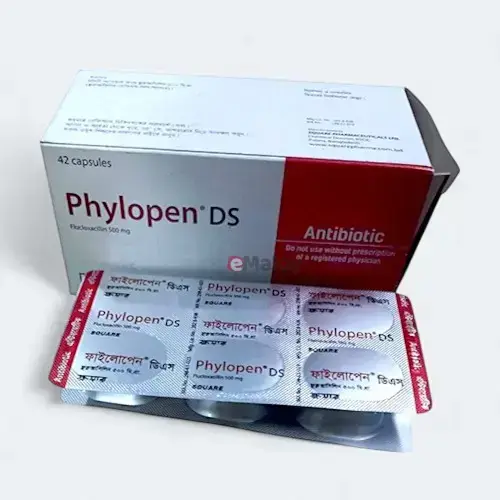
Phylopen DS (Flucloxacillin): A Penicillinase-Resistant Penicillin Antibiotic
Phylopen DS contains Flucloxacillin, an antibiotic that belongs to the penicillinase-resistant penicillin class. It is primarily used to treat bacterial infections caused by Gram-positive organisms, especially those producing penicillinase (an enzyme that breaks down many penicillins).
How Phylopen DS Works (Pharmacology)
Flucloxacillin is a bactericidal antibiotic that acts by:
- Inhibiting Bacterial Cell Wall Synthesis: It interferes with the final step of bacterial cell wall synthesis by binding to specific penicillin-binding proteins (PBPs) inside the bacterial cell wall. This weakens the cell wall, leading to swelling and eventual rupture of the bacterial cell.
- Penicillinase Resistance: Flucloxacillin is resistant to hydrolysis by bacterial penicillinase enzymes. This resistance is thought to be due to the steric hindrance from its acyl side chain, which prevents the opening of the β-lactam ring, thus protecting it from enzymatic breakdown.
- Gastric Acid Stability: It is stable in gastric acid conditions, allowing for effective oral administration.
- Gram-Positive Activity: It is effective against many Gram-positive organisms, including penicillinase-producing staphylococci. Its efficacy against Gram-negative bacilli is limited.
Key Indications & Benefits
Phylopen DS is indicated for the treatment of mild to moderately severe bacterial infections caused by penicillin-susceptible pathogens, including those due to penicillinase-producing staphylococci. These indications include:
- Skin and Soft Tissue Infections: Boils, abscesses, carbuncles, furunculosis, cellulitis, infected skin conditions (e.g., ulcers, eczema, acne, infected wounds, infected burns), otitis media and externa, impetigo, and protection for skin grafts.
- Respiratory Tract Infections: Pneumonia, lung abscess, empyema, sinusitis, pharyngitis, tonsillitis, and quinsy.
- Other Infections: Osteomyelitis, enteritis, endocarditis, urinary tract infections, meningitis, and septicemia caused by Flucloxacillin-sensitive organisms.
- Prophylaxis: As a prophylactic agent during major surgical procedures, particularly in cardiothoracic and orthopedic surgery, when appropriate.
Dosage & Administration
Oral doses of Flucloxacillin should be administered 1 hour before a meal for maximum absorption. Tablets are swallowed whole with sufficient liquid. Dry syrup/suspension bottles should be shaken vigorously before each use. Always consult a registered physician for medication use.
The dosage is determined by the sensitivity of the causative microorganism, severity of the infection, and patient's clinical response.
Oral Administration:
- Adults (including elderly): 250-500 mg four times a day.
- Dosage may be doubled in severe infections.
- For osteomyelitis and endocarditis, up to 8 grams daily may be administered in 6-8 hourly divided doses.
- Children (2-10 years): Half of the adult dose.
- Children (Under 2 years): A quarter of the adult dose.
Parenteral Administration (for severe cases or when oral is inappropriate, specific formulations):
- Adults or Elderly:
- Intramuscular (IM) Injection: 250 mg four times daily.
- Intravenous (IV) Injection: 250 mg - 1 gram four times daily by slow injection over 3-4 minutes or by intravenous infusion.
- All systemic doses may be doubled in severe infections; doses up to 8 grams daily have been suggested for endocarditis or osteomyelitis. Up to 12 grams daily for endocarditis in patients over 85 kg.
- Children:
- 2-10 years: Half of the adult dose.
- Under 2 years: A quarter of the adult dose.
- Other routes (in conjunction with systemic therapy): Intra-articular (250-500 mg daily), Intrapleural (250 mg daily), by nebulizer (125-250 mg four times daily).
Renal Impairment: For severe renal failure (creatinine clearance <10 ml/min), a dose reduction or extension of the dosing interval should be considered. Flucloxacillin is not significantly removed by dialysis, so no supplementary dose is needed during or after dialysis.
Important Considerations & Warnings
It is crucial to discuss your full medical history with your doctor before taking Phylopen DS.
Contraindications:
- Patients with hypersensitivity to penicillins (any type of penicillin) or any of the excipients of this medicine.
- History of liver problems (e.g., jaundice) after taking flucloxacillin.
- Patients with porphyria.
Side Effects:
- Common: Gastrointestinal upsets (e.g., nausea, vomiting, diarrhea, dyspepsia, minor GI disturbances), skin rashes (urticaria, morbilliform or scarlatiniform rashes, pruritus). If a skin rash occurs, treatment should be discontinued.
- Less common/Serious: Eosinophilia, more serious allergic reactions (e.g., drug fever, vasculitis, serum sickness, interstitial nephritis).
- Severe allergic reactions (rare but potentially fatal): Anaphylactic or anaphylactoid reactions (e.g., angioneurotic edema, laryngeal edema, bronchial spasm, shock). Treatment must be terminated immediately if these signs occur.
- Liver effects: Hepatitis, cholestatic jaundice (can be delayed up to 2 months after treatment). Use with caution in patients with liver dysfunction.
- Severe bullous skin reactions (isolated cases): Stevens-Johnson syndrome, Lyell's syndrome (toxic epidermal necrolysis), acute generalized exanthematous pustulosis.
- Blood picture changes (isolated cases, especially with high doses/prolonged administration): Reduction in white blood cells (leucopenia, granulocytopenia, agranulocytosis), red blood cells (hemolytic anemia), platelets (thrombocytopenia), pancytopenia, myelosuppression.
- Neurotoxicity: CNS toxicity including convulsions (especially with very high doses in poor renal function), confusion, impairment of consciousness, movement disorders (encephalopathy risk).
- Other: Dry mouth, taste disorders (rare), Herxheimer's reaction (during spirochetal infection treatment), drug-induced aseptic meningitis (isolated cases), transient tooth discoloration (extremely rare), hypokalemia (low potassium levels, especially with high doses).
Pregnancy & Lactation:
- Pregnancy: Flucloxacillin is classified as US FDA Pregnancy Category B. While animal studies show low or no adverse effects, there are no adequate and well-controlled studies in pregnant women. It should be used during pregnancy only if clearly needed and considered essential by the clinician. Use during the second and third trimesters may result in sensitization of the fetus.
- Lactation: Flucloxacillin has been detected in human milk in trace quantities. Caution should be exercised when administering to a lactating mother. Diarrhea and yeast colonization of mucous membranes may occur in the infant.
Precautions & Warnings:
- Cross-Allergy: The possibility of cross-allergy between cephalosporins and penicillins must be considered.
- Cardiac/Electrolyte Disturbances: The potassium content of Flucloxacillin preparations (especially sodium salt forms) may need to be considered when treating patients with heart diseases or serious electrolyte disturbances.
- Renal Impairment: Exercise caution in patients with severe renal impairment due to the risk of neurotoxicity at very high doses.
- Hepatic Dysfunction: Use with caution in patients with hepatic dysfunction.
- Allergic Diathesis: Caution is advised in patients with allergic diathesis.
- Resistant Microorganisms: Prolonged antibiotic administration may lead to the proliferation of resistant microorganisms. Patient condition must be checked regularly, and appropriate measures taken if a secondary infection occurs.
- Diabetes Mellitus: The sugar content of dry syrup/suspension preparations must be considered for diabetic patients.
- Driving/Operating Machinery: Phylopen DS does not usually affect the ability to drive or operate machinery. However, if adverse reactions such as encephalopathy (convulsions, confusion, impaired consciousness, movement disorders) occur, the patient should not operate machines or drive a vehicle.
- Intrathecal Route: Avoid intrathecal administration.
- Suprainfection: Be aware of suprainfection with penicillin-resistant organisms with prolonged use.
- Serum Potassium: Monitor serum potassium concentration, renal, and hematological status.
Drug Interactions:
- Probenecid: Concurrent administration leads to higher serum peak concentrations and prolonged therapeutic concentrations of Flucloxacillin.
- Methotrexate: May lead to increased levels of methotrexate in serum and potentiate its toxic effects. Monitoring of methotrexate serum levels is necessary.
- Bacteriostatic drugs (e.g., tetracyclines, chloramphenicol): May interfere with or attenuate the bactericidal effect of Flucloxacillin.
- Oral Contraceptives: Administration of penicillins may cause a transient reduction in plasma concentrations of estrogens and gestagens, making the effectiveness of oral contraceptives uncertain.
- Aminoglycosides (e.g., gentamicin, streptomycin): Physical incompatibility and/or loss of activity of Flucloxacillin have been reported when mixed in solution with aminoglycosides. Flucloxacillin should not be added to intravenous lipids, blood products, and protein hydrolysates.
- Oral Anticoagulants (e.g., warfarin): Combined use may prolong prothrombin time/INR.
- Paracetamol: Concomitant use with high doses of Flucloxacillin, particularly in patients with risk factors (e.g., severe renal impairment, sepsis, malnutrition), may increase the risk of high anion gap metabolic acidosis.
Interference with laboratory and diagnostic tests:
- Non-enzymatic urine glucose determinations and tests for urobilinogen may give false-positive results.
Overdose Effects
- The toxicity of Flucloxacillin is low, and it has a broad therapeutic range.
- When a multiple therapeutic dose is taken orally once, Flucloxacillin has no acute toxicity.
- There is a risk of encephalopathy in cases of beta-lactam antibiotic administration, particularly in case of overdose or renal impairment.
- Management: Special measures other than discontinuation of the medication are generally not required. Elimination of Flucloxacillin can be accomplished through hemodialysis.
Storage Conditions
Store in a cool and dry place, protect from light and moisture. Keep out of children's reach.




Comment