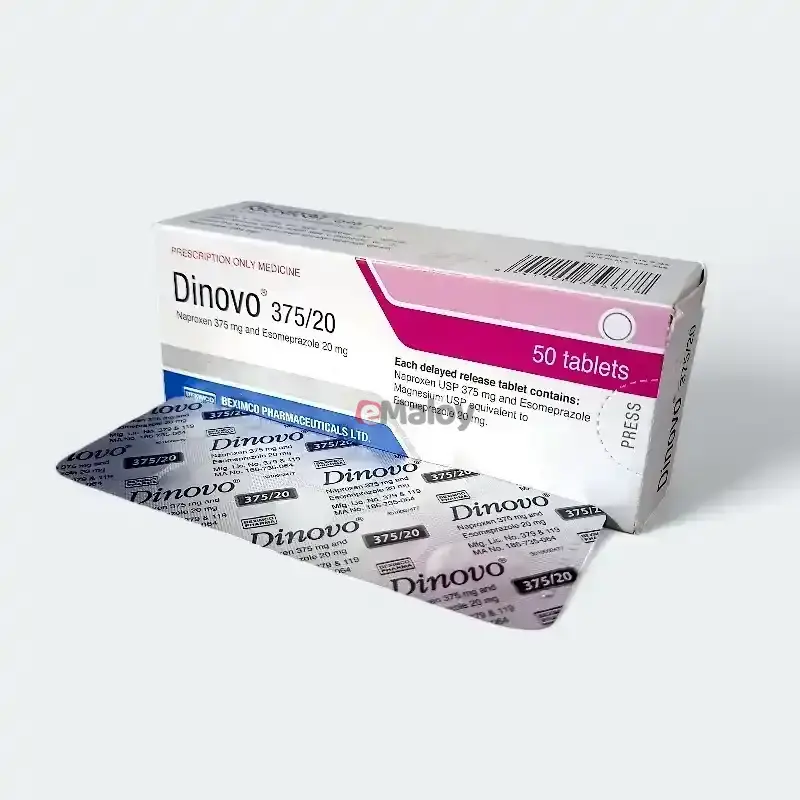
Dinovo 375: A Combination Therapy for Arthritis and Gastric Protection
Dinovo 375 is a unique tablet formulated to provide both pain and inflammation relief for musculoskeletal conditions, and to reduce the risk of associated gastric ulcers. It combines Naproxen, a Non-Steroidal Anti-Inflammatory Drug (NSAID), with Esomeprazole Magnesium, a Proton Pump Inhibitor (PPI).
How Dinovo 375 Works (Pharmacology)
Dinovo tablet features a dual-layer design:
- Immediate-release Esomeprazole Magnesium layer: This layer dissolves first, releasing Esomeprazole into the stomach to suppress acid production.
- Enteric-coated Naproxen core: This core dissolves later in the small intestine, delivering Naproxen for its systemic effects.
- Naproxen: As an NSAID, Naproxen works by inhibiting prostaglandin synthesis. Prostaglandins are chemicals that play a key role in causing inflammation, pain, and fever. By blocking their production, Naproxen reduces these symptoms.
- Esomeprazole: As a PPI, Esomeprazole suppresses gastric acid secretion by specifically inhibiting the H+/K+-ATPase (proton pump) in the gastric parietal cells. By blocking this final step in acid production, Esomeprazole reduces gastric acidity, thereby mitigating the gastrointestinal side effects often associated with NSAIDs like Naproxen.
Key Indications & Benefits
Dinovo 375 is indicated for the relief of signs and symptoms of:
- Osteoarthritis
- Rheumatoid arthritis
- Ankylosing spondylitis
- To decrease the risk of developing gastric ulcers in patients at risk of developing NSAID-associated gastric ulcers. This is a key benefit of the combination with Esomeprazole.
Dosage & Administration
Carefully consider the potential benefits and risks before using Dinovo 375. Use the lowest effective dose for the shortest duration consistent with individual patient treatment goals. If a total daily dose of Esomeprazole lower than 40 mg is more appropriate for a patient, a different treatment option should be considered.
General Administration:
- Do not split, chew, crush, or dissolve the tablet.
- Take at least 30 minutes before meals.
Dosing Recommendations for Adults (Rheumatoid Arthritis, Osteoarthritis, and Ankylosing Spondylitis):
- One tablet twice daily of either:
- 375 mg Naproxen / 20 mg Esomeprazole (Dinovo 375)
- Or 500 mg Naproxen / 20 mg Esomeprazole
Juvenile Idiopathic Arthritis in Adolescent Patients 12 Years of Age & Older:
- Weight greater than 50 kg: 375 mg Naproxen / 20 mg Esomeprazole; or 500 mg Naproxen / 20 mg Esomeprazole
- Weight 38 kg to less than 50 kg: One tablet twice daily of 375 mg Naproxen / 20 mg Esomeprazole.
Missed Dose:
- If a dose is missed, take it as soon as possible. However, if it's too close to the time for the next dose, only the prescribed dose should be taken at the appointed time. Do not take a double dose.
Always consult a registered physician for medication use.
Important Considerations & Warnings
It is crucial to discuss your full medical history with your doctor before taking Dinovo 375.
Contraindications:
- Known hypersensitivity to any component of this tablet or substituted benzimidazoles (e.g., other PPIs).
- History of asthma, urticaria, or other allergic-type reactions after taking aspirin or other NSAIDs.
- Use during the peri-operative period in the setting of coronary artery bypass graft (CABG) surgery.
Side Effects: The Esomeprazole component is included to reduce gastrointestinal (GI) side effects from Naproxen. This combination has been shown to significantly decrease gastric ulcers and NSAID-associated upper GI adverse events compared to Naproxen alone.
- Naproxen-related:
- Clinical trial and epidemiological data suggest NSAID use may be associated with a small increased risk of arterial thrombotic events (e.g., myocardial infarction or stroke), especially at high doses and long-term. While Naproxen (1000 mg daily) may have a lower risk, some risk cannot be excluded.
- Edema, hypertension, and cardiac failure have been reported with NSAID treatment.
- Gastrointestinal (most common): Peptic ulcers, perforation, or GI bleeding (sometimes fatal, particularly in older people) may occur. Nausea, vomiting, diarrhea, flatulence, constipation, dyspepsia, abdominal pain, melaena, haematemesis, ulcerative stomatitis, exacerbation of colitis, and Crohn’s disease have been reported. Less frequently, gastritis has been observed.
- Esomeprazole-related: Dyspepsia could still occur despite Esomeprazole. PPIs may lead to a slightly increased risk of gastrointestinal infections (e.g., Salmonella and Campylobacter) and might reduce vitamin B12 absorption with long-term therapy.
Interactions:
- Antihypertensive effects: Concomitant use with NSAIDs may reduce the antihypertensive effect of ACE inhibitors, diuretics, and beta-blockers.
- Warfarin: Increased risk of bleeding complications when used with warfarin.
- Gastric pH-dependent drugs: Esomeprazole inhibits gastric acid secretion and may interfere with the absorption of drugs where gastric pH is important for bioavailability (e.g., Ketoconazole, iron salts, and digoxin).
- Food: High-fat food does not affect the extent of Naproxen absorption but significantly prolongs the time to maximum concentration (tmax) by 10 hours and decreases peak plasma concentration (Cmax) by about 12%.
Pregnancy & Lactation:
- Pregnancy:
- Contraindicated during the third trimester of pregnancy.
- In women attempting to conceive or during the first and second trimester, it should not be given unless the potential benefit outweighs the potential risk to the fetus.
- Breast-feeding: Naproxen is excreted in low quantities in human milk. It is unknown if Esomeprazole is excreted in human milk. Should not be used during breastfeeding.
- Fertility: The use of NSAIDs like Naproxen may impair female fertility. The use of Dinovo 375 is not recommended in women attempting to conceive.
Precautions & Warnings:
- General: Avoid concomitant use with other NSAIDs (including COX-2 selective inhibitors) due to cumulative risks of NSAID-related adverse events. Can be used with low-dose aspirin. Use the lowest effective dose for the shortest duration.
- Risk Factors for GI complications: High age, concomitant use of anticoagulants, corticosteroids, other NSAIDs (including low-dose aspirin), debilitating cardiovascular disease, Helicobacter pylori infection, and a history of gastric/duodenal ulcers or upper GI bleeding. Patients with these factors should consider combination therapy with protective agents (e.g., misoprostol or PPIs).
- GI Bleeding/Ulceration: Report any unusual abdominal symptoms (especially GI bleeding). If GI bleeding or ulceration occurs, withdraw treatment. Use with care in patients with a history of GI disease (ulcerative colitis, Crohn’s disease) as these conditions may be exacerbated.
- Cardiovascular and cerebrovascular effects: Monitor patients with a history of hypertension and/or mild to moderate congestive heart failure. Use with caution in patients with uncontrolled hypertension, congestive heart failure, established ischemic heart disease, peripheral arterial disease, and/or cerebrovascular disease. Consider risks before long-term treatment in patients with cardiovascular risk factors (hypertension, hyperlipidemia, diabetes mellitus, smoking).
- Renal effects: Long-term NSAID administration can lead to renal papillary necrosis and other renal injury.
- Other conditions: Use Naproxen only after rigorous benefit-risk assessment in patients with inducible porphyrias, Systemic lupus erythematosus, and mixed connective tissue disease.
- Long-term treatment: Patients on long-term treatment (especially over a year) should be regularly monitored.
Use in Special Populations:
- Elderly patients: Unbound plasma fraction of Naproxen is increased. Use caution with high doses; dose adjustment may be required. Use the lowest effective dose.
- Moderate to Severe Renal Impairment: Not recommended for use (creatinine clearance <30 ml/min).
- Hepatic Insufficiency: Monitor patients with mild to moderate impairment closely; consider dose reduction based on the Naproxen component. Not recommended in severe hepatic impairment because Esomeprazole dosage should not exceed 20 mg daily in these patients.
Overdose Effects:
- Naproxen overdose: Symptoms may include lethargy, dizziness, drowsiness, epigastric pain, abdominal discomfort, heartburn, indigestion, nausea, transient alterations in liver function, hypoprothrombinemia, renal dysfunction, metabolic acidosis, apnea, disorientation, or vomiting. GI bleeding, hypertension, acute renal failure, respiratory depression, and coma are rare but possible. Anaphylactoid reactions can occur. Management is symptomatic and supportive; hemodialysis is not effective. Activated charcoal may be indicated within 4 hours.
- Esomeprazole overdose: Symptoms are typically transient, even at doses up to 240 mg/day. No specific antidote is known, and it is not readily dialyzable. Treatment is symptomatic and supportive.
Storage Conditions
Store below 30°C, protected from light & moisture. Keep out of reach of children.




Comment