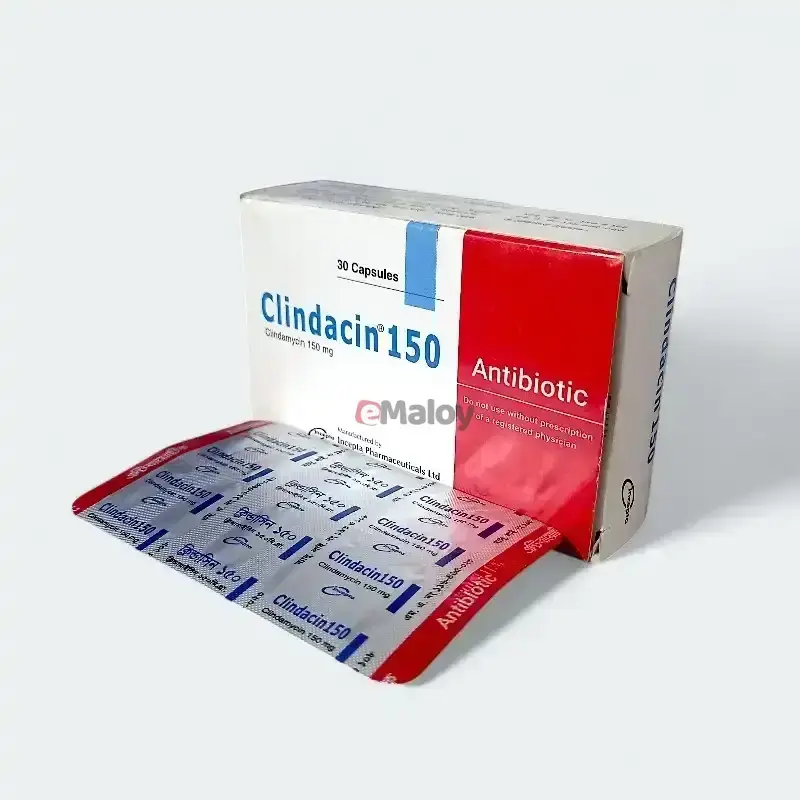
Clindacin 150: A Lincosamide Antibiotic for Bacterial and Parasitic Infections
Clindacin 150 is a lincosamide antibiotic used to treat infections caused by susceptible anaerobic bacteria and specific Gram-positive bacteria (Streptococci, Staphylococci, and Pneumococci). It also serves as an alternative therapy for multi-drug resistant Plasmodium falciparum malaria when combined with quinine or amodiaquine.
How Clindacin Works (Pharmacology)
Clindacin contains Clindamycin, a semisynthetic antibiotic derived from lincomycin. Clindamycin works by inhibiting bacterial protein synthesis, thereby stopping the growth and multiplication of susceptible microorganisms.
It is active against:
- Aerobic Gram-positive cocci: Including Staphylococcus aureus, Staphylococcus epidermidis (both penicillinase and non-penicillinase producing strains), Streptococci, and Pneumococci.
- Anaerobic Gram-negative bacilli: Including Bacteroides species and Fusobacterium species.
- Anaerobic Gram-positive non-spore forming bacilli: Including Propionibacterium species, Eubacterium species, and Actinomyces species.
- Anaerobic and microaerophilic Gram-positive cocci: Including Peptococcus species, Peptostreptococcus species, Microaerophilic streptococci, and Clostridium perfringens.
Key Indications & Benefits
Clindacin is effective in treating a wide range of infections, including:
- Upper and Lower Respiratory Infections
- Skin and Soft Tissue Infections
- Bone and Joint Infections
- Pelvic Infections
- Intra-abdominal Infections
- Septicemia and Endocarditis
- Dental Infections
- Multi-drug Resistant Plasmodium falciparum Infection (as an alternative therapy in combination with quinine or amodiaquine)
Dosage & Administration
The dosage of Clindamycin varies by formulation (capsule, oral solution, IV/IM injection) and severity of infection.
Clindamycin Capsule:
- Serious Infections: 150 mg-300 mg every six hours.
- More Severe Infections: 300 mg-450 mg every six hours.
- To avoid esophageal irritation, capsules should be taken with a full glass of water.
- Some research supports twice-daily dosing of 300 mg for SSTIs & RTIs (as plasma concentrations remain above MIC90 for more than 12 hours).
- For bone & joint infections, diabetic foot infections: 300 mg capsule 3-4 times daily.
Clindamycin Powder for Oral Solution (Pediatric):
- Serious Infections: 8-12 mg/kg/day divided into 3 or 4 equal doses.
- Severe Infections: 13-16 mg/kg/day divided into 3 or 4 equal doses.
- More Severe Infections: 17-25 mg/kg/day divided into 3 or 4 equal doses.
- For pediatric patients weighing 10 kg or less, the minimum recommended dose is 1/2 teaspoon (37.5 mg) three times a day.
Clindamycin IV/IM Injection:
- Adults:
- Serious infections (aerobic gram-positive cocci and susceptible anaerobes): 600-1200 mg/day in 2-4 equal doses.
- More severe infections: 1200-2700 mg/day in 2-4 equal doses.
- For life-threatening situations, doses up to 4800 mg daily intravenously have been given.
- Single intramuscular injections greater than 600 mg are not recommended.
- Neonates (<1 month): 15 to 20 mg/kg/day in 3 to 4 equal doses (lower effective dosage for small prematures).
- Pediatric patients (1 month to 16 years): 20 to 40 mg/kg/day in 3 or 4 equal doses (higher doses for more severe infections).
- Parenteral therapy may be switched to oral capsules when appropriate.
- For β-hemolytic streptococcal infections, treatment should continue for at least 10 days.
Reconstitution (Powder for oral solution): Shake the bottle to loosen powder. Add 80 ml of boiled and cooled water in two portions, shaking well after each addition. The reconstituted solution is stable for 2 weeks at room temperature.
Dilution of Injection for IV use: Must be diluted before IV administration. Concentration should not exceed 18 mg/ml. Infusion rates should not exceed 30 mg/minute. More than 1200 mg in a single 1-hour infusion is not recommended. Dilution is not required for IM administration.
Always consult a registered physician for medication use.
Important Considerations & Warnings
Discuss your full medical history with your doctor before taking Clindacin.
Contraindications:
- Patients with a history of hypersensitivity to clindamycin or any of the medicine's ingredients.
Side Effects: Reported adverse effects include:
- Abdominal pain
- Esophagitis and esophageal ulcer
- Nausea, vomiting, and diarrhea
- Pruritus (itching)
- Skin rashes, urticaria (hives)
Interactions:
- Neuromuscular blocking agents: Clindacin enhances their action, so use with caution.
- Erythromycin: Antagonism has been demonstrated in vitro; these two drugs should not be administered concurrently due to possible clinical significance.
Pregnancy & Lactation:
- Pregnancy Category B. Clindamycin crosses the placenta. Use during pregnancy only if clearly needed.
- Lactation: Clindamycin has been reported in breast milk. Not recommended for nursing mothers if not clearly needed.
Precautions & Warnings:
- Use with caution in individuals with a history of gastrointestinal disease, particularly colitis.
- Newborns and infants: Appropriate monitoring of organ system functions is desirable.
- Geriatric use: Dose adjustment is not necessary.
Overdose Effects:
- Overdosage with orally administered Clindacin is rare. Expected adverse reactions are similar to normal doses, but unexpected reactions could occur.
- Hemodialysis and peritoneal dialysis are not effective in removing Clindacin from the serum.
- Overdosage should be treated with simple gastric lavage. No specific antidote is known.
Storage Conditions
Keep below 30°C temperature, away from light & moisture. Keep out of the reach of children.



Comment