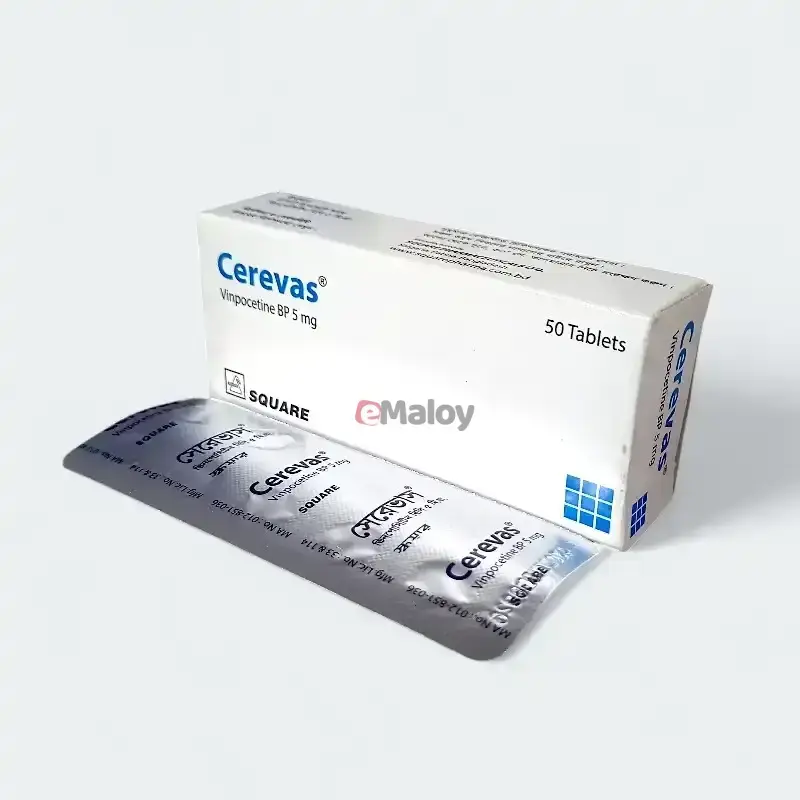
Cerevas 5: Enhancing Cerebral Blood Flow and Metabolism
Cerevas 5 is a medication primarily used to improve cerebral (brain) blood flow and metabolism. It is indicated for a range of conditions related to impaired brain circulation and function, as well as certain visual and hearing disorders.
How Cerevas 5 Works (Pharmacology)
Cerevas 5 contains Vinpocetine, which exerts its therapeutic effects through several mechanisms:
- Increases Cerebral Metabolism: Vinpocetine enhances the brain's consumption of glucose and oxygen, shifting glucose metabolism towards the more energetically favorable aerobic pathway while also increasing the anaerobic pathway. This leads to elevated ATP (energy currency) concentration and an improved ATP/AMP ratio in the brain. It also elevates levels of norepinephrine, dopamine, and serotonin in the brain, which are important neurotransmitters.
- Improves Cerebral Microcirculation: It significantly improves blood flow in the small vessels of the brain by:
- Inhibiting platelet aggregation, which prevents blood clot formation.
- Reducing pathologically increased blood viscosity (thickness).
- Increasing erythrocyte (red blood cell) deformability, allowing red blood cells to navigate narrow capillaries more easily.
- Enhances Oxygen Transport: Vinpocetine promotes oxygen transport into tissues by reducing the oxygen affinity of erythrocytes.
- Selectively Increases Cerebral Blood Flow: It selectively and intensely increases blood flow to the brain and increases the brain's share of the cardiac output. It reduces cerebral vascular resistance without affecting systemic circulation (blood pressure, heart rate, cardiac output, total peripheral resistance).
- "Inverse Steal" Effect: Vinpocetine does not cause a "steal phenomenon" (where blood is diverted from an ischemic area to a healthy area). On the contrary, it primarily improves blood supply to injured and ischemic areas while leaving blood flow unchanged in intact areas. This is known as the "inverse steal effect," and it further increases blood flow that is already elevated due to hypoxia (low oxygen).
Key Indications & Benefits
Cerevas 5 is indicated for various conditions, including:
- Acute Cerebro-Vascular Accidents (Strokes):
- Ischemic strokes (due to cerebral thrombosis, cerebral embolism, acute circulatory disorder).
- Hypertensive crisis, ischemic neurological deficit, complete stroke (CS), multi-infarct dementia, cerebral arteriosclerosis, hypertensive encephalopathy, and post-apoplectic conditions (even with a history of hemorrhagic strokes).
- Senile Disorder: For the relief of psychosomatic symptoms in the elderly due to cerebral insufficiency, such as forgetfulness, memory disturbances, slow thinking, lack of concentration, dizziness, mood instability, aphasia, sleep disturbances, and vasovegetative symptoms of menopausal syndrome.
- Visual Disorder: Vascular disorders of the choroid and retina due to arteriosclerosis, vasospasm, macular degenerations, arterial or venous thrombosis or embolism, and glaucoma secondary to these disorders.
- Hearing Disorder: For the treatment of impaired hearing of vascular or toxic (iatrogenic) origin, presbycusis, Meniere's disease, cochleovestibular neuritis, tinnitus (ringing in the ears), and dizziness of labyrinth origin.
Always consult a registered physician for medication use.
Dosage & Administration
The dosage and route of administration for Cerevas 5 vary based on the stage and severity of the condition.
- Tablet (Oral):
- Initial: 1-2 tablets three times daily.
- Maintenance: 1 tablet three times daily.
- Intramuscular (IM) Injection:
- Daily dose of 20-40 mg until symptoms improve (for no longer than 10 days).
- Followed by oral treatment.
- If this regimen fails, intravenous (IV) infusion treatment should be considered.
- Intravenous (IV) Infusion:
- Daily starting dose: 20 mg in slow drip infusion (2 ampoules in 500-1000 ml infusion solution).
- This dose can be increased to 1 mg/kg body weight over 3 to 4 days.
- Treatment should be continued for 10-14 days, depending on patient tolerance.
- The dose should be gradually reduced before discontinuation of treatment.
Always consult a registered physician for medication use.
Important Considerations & Warnings
It is crucial to discuss your full medical history with your doctor before taking Cerevas 5.
Contraindications:
- Parenteral Treatment (IM/IV):
- Severe ischemic heart disease.
- Severe rhythm disorders.
- Pregnancy.
- Overall: The drug is contraindicated during pregnancy and lactation.
Side Effects:
- Transient hypotension (temporary low blood pressure).
- Tachycardia (rapid heart rate) may occur.
Interactions:
- Heparin: The injection form of Vinpocetine is chemically incompatible with heparin and should not be injected in the same syringe.
Pregnancy & Lactation:
- The drug is contraindicated during pregnancy and lactation.
Precautions & Warnings:
- In the acute stage of conditions, parenteral (IM or IV) treatment is recommended until symptoms improve, followed by oral treatment.
- In chronic cases, oral therapy should be applied.
Storage Conditions
Store in a cool and dry place, protected from light and moisture.



Comment