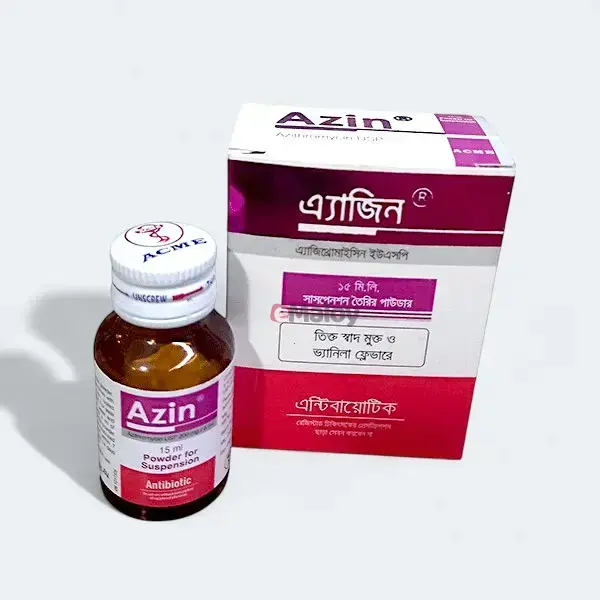
Azin (Azithromycin): A Macrolide Antibiotic for Bacterial Infections
Azin contains Azithromycin, a broad-spectrum macrolide antibiotic. It is indicated for the treatment of various bacterial infections, particularly those in the respiratory tract, skin and soft tissues, and certain sexually transmitted diseases.
How Azin Works (Pharmacology)
Azithromycin works by binding to the 50S ribosomal subunit of susceptible microorganisms. This action interferes with microbial protein synthesis, halting the growth and replication of bacteria. Nucleic acid synthesis (DNA/RNA) is not affected.
Key Pharmacological Features:
- Acid-stable and well-absorbed: Can be taken orally without protection from gastric acids, though absorption is better on an empty stomach. Peak plasma concentration occurs 2.1 to 3.2 hours after oral administration.
- High tissue concentration: Actively transported to infection sites due to high concentration in phagocytes (immune cells). During active phagocytosis, large amounts of azithromycin are released, leading to tissue concentrations that can be over 50 times higher than in plasma (due to ion trapping and high lipid solubility).
- Long half-life: Has a prolonged terminal elimination half-life of 68 hours, allowing for large single doses and maintaining bacteriostatic levels in infected tissue for several days. This long half-life is attributed to extensive uptake and subsequent slow release from tissues.
- Elimination: Primarily eliminated via biliary excretion (unchanged drug). Approximately 6% of the administered dose appears as unchanged drug in urine over a week.
Microbiology: Azithromycin is active against a wide range of bacteria, including:
- Aerobic & facultative Gram-positive: Staphylococcus aureus, Streptococcus agalactiae, Streptococcus pneumoniae, Streptococcus pyogenes, Streptococci (Groups C, F, G), Viridans group streptococci.
- Aerobic & facultative Gram-negative: Haemophilus ducreyi, Haemophilus influenzae, Moraxella catarrhalis, Neisseria gonorrhoeae, Bordetella pertussis, Legionella pneumophila.
- Other Microorganisms: Chlamydia pneumoniae, Chlamydia trachomatis, Mycoplasma pneumoniae.
- Anaerobic Microorganisms: Peptostreptococcus species, Prevotella bivia.
- Beta-lactamase production (by bacteria) does not affect azithromycin activity.
Key Indications & Benefits
Azin is indicated for infections caused by susceptible organisms in:
- Lower Respiratory Tract Infections: Including bronchitis and pneumonia.
- Upper Respiratory Tract Infections: Including sinusitis and pharyngitis/tonsillitis.
- Otitis media (middle ear infection).
- Skin and Soft Tissue Infections.
- Sexually Transmitted Diseases (in men and women): Specifically, non-gonococcal urethritis and cervicitis due to Chlamydia trachomatis.
Dosage & Administration
Azin is available in oral forms (tablet, suspension) and as an IV infusion. Always consult a registered physician for medication use.
Oral Dosage (preferably taken at least 1 hour before or 2 hours after a meal):
- Adults:
- 500 mg once daily orally for 3 days.
- OR 500 mg once on Day 1, then 250 mg once on Days 2-5 (total 4 days).
- For sexually transmitted diseases caused by Chlamydia trachomatis: 1 gm as a single dose OR 500 mg once on Day 1, followed by 250 mg once daily for the next 2 days.
- Children (over 6 months):
- 10 mg/kg body weight once daily for 3 days.
- Weight-based suspension dosing:
- 15-25 kg: 200 mg (1 teaspoonful) for 3 days.
- 26-35 kg: 300 mg (1½ teaspoonfuls) for 3 days.
- 36-45 kg: 400 mg (2 teaspoonfuls) for 3 days.
- For typhoid fever: 500 mg (2½ teaspoonfuls) once daily for 7-10 days.
Azithromycin Injection (For IV Infusion only):
- Community-Acquired Pneumonia (Adults):
- 500 mg as a single daily dose by IV route for at least two days.
- Followed by 500 mg once daily orally (two 250-mg tablets) to complete a 7 to 10-day course. Switch timing at physician's discretion based on clinical response.
- Pelvic Inflammatory Disease (Adults):
- 500 mg as a single daily dose by IV route for one or two days.
- Followed by 250 mg once daily orally to complete a 7-day course. Switch timing at physician's discretion.
- If anaerobic microorganisms are suspected, administer an antimicrobial agent with anaerobic activity in combination with Azithromycin.
- Children/Adolescents under 16 years: Safety and effectiveness of azithromycin injection have not been established.
Suspension Reconstitution:
- Shake the bottle well to loosen the powder.
- Add boiled and cooled water up to the water mark on the bottle label.
- Shake until the powder is completely mixed with water.
Important Considerations & Warnings
It is crucial to discuss your full medical history with your doctor before taking Azin.
Contraindications:
- Patients with known hypersensitivity to Azithromycin or any other macrolide antibiotic.
- Co-administration of ergot derivatives and Azithromycin is contraindicated due to theoretical possibility of ergotism.
- Patients with hepatic diseases.
Side Effects:
- Azin is generally well tolerated with a low incidence of side effects, most being mild to moderate.
- Most common (gastrointestinal): Nausea, abdominal discomfort (pain/cramps), vomiting, flatulence, diarrhea, and loose stools (occasionally observed).
- Allergic reactions: Rash or photosensitivity have occurred. Rare reports of serious hypersensitivity reactions, including angioedema and anaphylaxis (some recurrent and requiring prolonged observation).
- Liver: Reversible elevations in liver transaminases (similar frequency to comparative macrolides/penicillins). Rarely, cases of cholestatic jaundice observed.
- Blood: Transient mild reductions in neutrophil counts occasionally observed (causal relationship not established).
- Hearing impairment: Reversible hearing impairment seen in some patients in investigational studies using higher doses for prolonged periods.
Pregnancy & Lactation:
- Pregnancy: US FDA Pregnancy Category B. Animal reproduction studies show no evidence of harm to the fetus. However, there are no adequate and well-controlled studies in pregnant women. Azithromycin should be used during pregnancy only if adequate alternatives are not available, as animal studies are not always predictive of human response.
- Lactation: It is not known whether Azithromycin is secreted in human milk. Caution should be exercised when Azithromycin is administered to nursing women.
Precautions & Warnings:
- Allergic Reactions: As with other macrolides, rare serious allergic reactions (including angioneurotic edema and anaphylaxis) have been reported. Some have resulted in recurrent symptoms requiring long observation and treatment.
- Renal Impairment: No dose adjustment needed in mild renal impairment (creatinine clearance $>$40 ml/min). Caution should be exercised in patients with more severe renal impairment as data is lacking.
- Hepatic Impairment: As the liver is the principal route of excretion, Azithromycin should not be used in patients with hepatic disease.
- Driving/Operating Machinery: There is no evidence to suggest Azithromycin affects ability to drive or operate machinery.
Drug Interactions:
- Antacids: Azithromycin should be taken at least 1 hour before or 2 hours after antacids.
- Carbamazepine, Methylprednisolone, Theophylline, Warfarin, Terfenadine: No significant pharmacokinetic or pharmacodynamic interactions observed, but general monitoring (e.g., INR for warfarin, theophylline levels) is advised.
- Cyclosporine: Some related macrolides interfere with cyclosporine metabolism. Caution should be exercised; if co-administration is necessary, cyclosporine levels should be monitored and dose adjusted.
- Digoxin: Some macrolides impair digoxin metabolism in the gut. Possibility of raised digoxin levels should be borne in mind, and digoxin levels monitored.
- Ergot derivatives: Due to the theoretical possibility of ergotism, Azithromycin and ergot derivatives should not be co-administered.
Overdose Effects
- There is no specific data on overdosage with Azin.
- Typical symptoms of overdosage with macrolide antibiotics include hearing loss, severe nausea, vomiting, and diarrhea.
- Management: Gastric lavage and general supportive measures are indicated.
Storage Conditions
Keep in a dry place away from light and heat. Keep out of the reach of children.



Comment