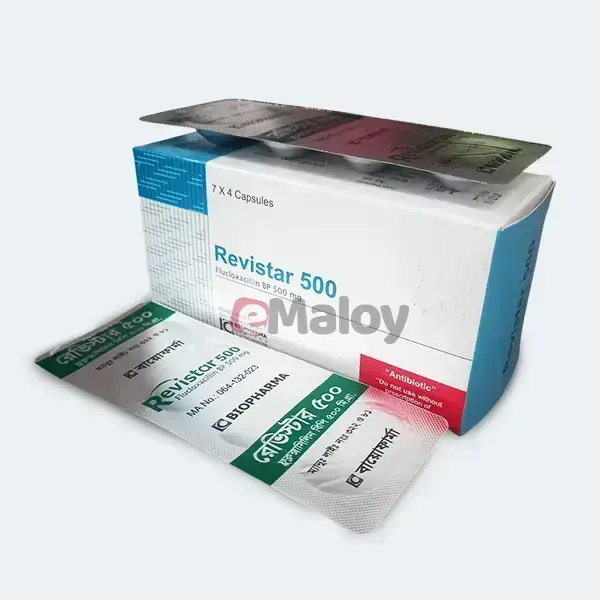
Revistar 500 mg is a capsule containing Flucloxacillin 500 mg (as Flucloxacillin Sodium BP).
It is manufactured by Biopharma Limited in Bangladesh.
Indications:
Flucloxacillin is a narrow-spectrum antibiotic belonging to the penicillin group. It is particularly effective against Gram-positive organisms, including those that produce penicillinase (an enzyme that breaks down many penicillins, making them ineffective). This makes it suitable for infections caused by Staphylococcus aureus (including penicillinase-producing strains) and Streptococcus species.
Common indications include:
- Skin and soft tissue infections:Boils, abscesses, carbuncles, furunculosis, cellulitis, infected skin conditions (e.g., ulcers, eczema, acne), infected wounds, infected burns, impetigo, and otitis media/externa.
- Respiratory tract infections: Pneumonia, lung abscess, empyema, sinusitis, pharyngitis, tonsillitis, and quinsy.
- Other infections: Osteomyelitis (bone infection), enteritis, endocarditis (heart valve infection), urinary tract infections, meningitis, and septicaemia (blood poisoning) caused by Flucloxacillin-sensitive organisms.
- Prophylaxis: Used as a preventive agent during major surgical procedures, such as cardiothoracic and orthopedic surgery.
Pharmacology:
Flucloxacillin is a bactericidal antibiotic. It works by inhibiting the third and final step of bacterial cell wall synthesis. It binds to specific penicillin-binding proteins (PBPs) within the bacterial cell, preventing the formation of peptidoglycan, a crucial component that provides mechanical stability to the cell wall. This weakens the bacterial cell wall, leading to cell swelling and eventual rupture. Flucloxacillin is resistant to bacterial penicillinase due to its unique chemical structure, which protects its β-lactam ring from hydrolysis by this enzyme.
Dosage and Administration:
Revistar 500 mg capsules should be administered orally half to one hour before meals to ensure optimal absorption. The usual adult dosage (including elderly patients) is 500 mg four times daily.
- In severe infections: The dosage may be doubled (e.g., 1 gm four times daily).
- In osteomyelitis and endocarditis: Doses up to 8 gm daily may be given in divided doses every 6 to 8 hours.
- In case of secondary bacterial infection in chickenpox: Flucloxacillin 500 mg six hourly is often prescribed.
Children's Dosage (under medical supervision):
- 2-10 years: Half of the adult dose.
- Under 2 years: Quarter of the adult dose.
Dose adjustment in renal impairment: In severe renal failure (creatinine clearance < 10 ml/min), a reduction in dose or an extension of the dose interval should be considered. Flucloxacillin is not significantly removed by dialysis.
Side Effects:
Side effects are uncommon and mostly mild and temporary. They can include:
- Gastrointestinal upsets: Nausea, vomiting, diarrhea, dyspepsia (indigestion), and other minor gastrointestinal disturbances.
- Skin rashes: If a skin rash occurs, treatment should be discontinued immediately.
- Other rare effects: Urticaria (hives), purpura (small red or purple spots on the skin), fever, interstitial nephritis (kidney inflammation), hepatitis (liver inflammation), and cholestatic jaundice (bile flow obstruction).
Contraindications:
- Known penicillin hypersensitivity (allergy) to Flucloxacillin or any other penicillin antibiotic.
- Patients with a history of cholestatic jaundice/hepatic dysfunction associated with Flucloxacillin.
Precautions and Warnings:
- Allergic Reactions: Patients with a history of allergies (e.g., asthma, eczema, hay fever) should use Flucloxacillin with caution due to an increased risk of hypersensitivity reactions.
- Liver Impairment: Use with caution in patients with hepatic impairment. Liver function tests may be required, especially with prolonged therapy or in patients with pre-existing liver disease.
- Renal Impairment: Although generally no dose reduction is needed for mild to moderate renal impairment, caution and dose adjustment are necessary in severe renal failure.
- Prolonged Use: Prolonged use may lead to overgrowth of non-susceptible organisms, including fungi, or a decrease in white blood cell count.
- Porphyria: Avoid use in patients with porphyria (a group of rare genetic disorders).
Pregnancy and Lactation:
- Pregnancy (US FDA Pregnancy Category B): The use of Flucloxacillin during pregnancy should be reserved for cases considered essential by the clinician. Animal studies have shown low or no risk, but there are no adequate and well-controlled studies in pregnant women. Use in the second and third trimesters may theoretically result in sensitization of the fetus.
- Lactation: Trace quantities of penicillin can be detected in breast milk. Caution should be exercised when administering Flucloxacillin to a breastfeeding mother.
Drug Interactions:
- Probenecid: Co-administration with probenecid (a uricosuric drug) results in higher and prolonged serum concentrations of Flucloxacillin, as probenecid reduces its renal excretion.
- Methotrexate: Flucloxacillin may increase the risk of methotrexate toxicity by inhibiting its renal excretion.
- Oral Contraceptives: May decrease the efficacy of estrogen-containing oral contraceptives; advise patients to use alternative contraception.
- Aminoglycosides: Flucloxacillin should not be mixed directly with aminoglycoside antibiotics (e.g., Gentamicin, Streptomycin) in solution due to physical incompatibility and/or loss of activity.
- Warfarin: Although not a strong interaction, caution is advised as penicillin antibiotics can rarely alter gut flora, potentially affecting vitamin K production and thus warfarin's effects. Monitor INR if co-administered.
Storage Conditions:
Store below 30°C, away from light and moisture. Keep out of the reach of children.
Note: This information is for general knowledge and informational purposes only and does not substitute professional medical advice. Always consult your doctor or pharmacist for specific instructions and guidance regarding your medication.




Comment