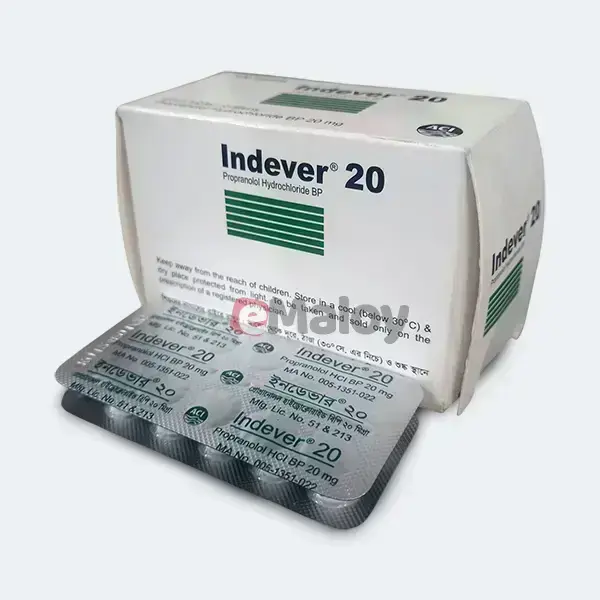
Indever 20 is a tablet containing Propranolol Hydrochloride BP 20 mg. It is manufactured by ACI Limited in Bangladesh.
Indications:
Indever 20 belongs to a class of medicines called beta-blockers. It is widely used to treat various conditions, including:
- Essential and Renal Hypertension (high blood pressure)
- Angina Pectoris (chest pain due to reduced blood flow to the heart)
- Cardiac Arrhythmias (irregular heartbeats)
- Long-term prophylaxis after recovery from acute myocardial infarction (heart attack prevention)
- Prophylaxis of Migraine (prevention of migraine headaches)
- Essential Tremor (involuntary rhythmic trembling)
- Anxiety and Anxiety Tachycardia (anxiety-related rapid heartbeat)
- Adjunctive management of Thyrotoxicosis and Thyrotoxic Crisis (overactive thyroid conditions)
- Hypertrophic Obstructive Cardiomyopathy (a heart muscle disease)
- Phaeochromocytoma (a rare tumor of the adrenal gland, used with an alpha-blocker).
Pharmacology:
Propranolol is a non-selective beta-adrenergic receptor blocking agent. It competitively blocks both beta-1 and beta-2 adrenergic receptors. This action reduces the heart rate and force of contraction, lowers blood pressure, and decreases the heart's oxygen demand. It is almost completely absorbed from the gastrointestinal tract, but a portion is metabolized by the liver on its first pass. Peak plasma concentration occurs in 1 to 1.5 hours after oral administration, and the plasma half-life is 3 to 6 hours. Its metabolites are primarily excreted through the urine.
Dosage and Administration:
Dosage varies depending on the condition being treated and individual response. It should be taken as advised by a doctor. Generally, it's recommended to take it on an empty stomach or before meals.
- Adults (above 18 years):
- Hypertension: Initially 80 mg twice daily, may be increased at weekly intervals. Usual range: 160-320 mg daily.
- Angina, Anxiety, Migraine, Essential Tremor: A starting dose of 40 mg two or three times daily, increased at weekly intervals. Adequate response is usually seen in the range of 80-160 mg/day for anxiety, migraine, and essential tremor, and 120-240 mg/day for angina.
- Dysrhythmias, Anxiety Tachycardia, Hypertrophic Obstructive Cardiomyopathy, Thyrotoxicosis: A dosage range of 10-40 mg three or four times a day usually achieves the required response.
- Post myocardial infarction: Treatment starts between days 5 and 21 after MI, with an initial dose of 40 mg four times a day for 2-3 days, then 80 mg twice a day.
- Children (From day 1 to 18 years): Dosage is individually determined.
- Hypertension: Neonates: 0.25-0.5 mg/kg 3 times daily. Child 1 month - 12 years: 0.25-1 mg/kg 3 times daily, max 5 mg/kg daily. Child 12-18 years: initially 80 mg twice daily, maintain 160-320 mg daily.
- Migraine (under 12 years): 20 mg two or three times daily.
Contraindications:
Indever 20 is contraindicated in patients with:
- Known hypersensitivity to Propranolol or any component of the formulation.
- Bronchial asthma or bronchospasm (e.g., chronic bronchitis, emphysema).
- Cardiogenic shock.
- Second or third-degree heart block (without a pacemaker).
- Sick sinus syndrome.
- Sinus bradycardia (very slow heart rate).
- Raynaud's phenomenon.
- Diabetes Mellitus (use with extreme caution as it may mask hypoglycemia symptoms).
- Overt heart failure (unless adequately controlled).
Side Effects:
Propranolol is usually well tolerated. Most adverse effects are mild and transient. Common side effects include:
- Cold extremities (hands and feet)
- Nausea, diarrhea
- Sleep disturbances (insomnia)
- Lassitude (tiredness, lack of energy)
- Dizziness, headache
- Paresthesia (tingling or numbness)
- Fatigue, mental confusion, hallucinations (rare)
- Skin rashes and/or dry eyes (rare)
Serious (rare) side effects can include:
- Significant bradycardia (very slow heart rate)
- Bronchospasm (especially in predisposed individuals)
- Hypotension (low blood pressure)
- Worsening of heart failure
Precautions and Warnings:
- Heart Failure: Avoid in overt heart failure unless heart failure is secondary to a tachyarrhythmia treatable with propranolol.
- Diabetic Patients: May mask the symptoms of hypoglycemia (low blood sugar), such as fast heartbeat. Monitor blood sugar levels regularly.
- Respiratory Conditions: Use with extreme caution in patients with a history of non-allergic bronchospasm (e.g., chronic bronchitis, emphysema).
- Renal and Hepatic Impairment: Use with caution, and dose adjustments may be necessary.
- Abrupt Withdrawal: Do not stop taking the medication suddenly without consulting a doctor, as it can worsen heart conditions. Gradually reduce the dose over several weeks.
- Driving/Operating Machinery: May cause visual disturbances, fatigue, or dizziness; caution is advised.
Pregnancy and Lactation:
- Pregnancy: Propranolol is Pregnancy Category C (D in 2nd & 3rd trimesters). There are no adequate and well-controlled studies in pregnant women. It should be used during pregnancy only if the potential benefit justifies the potential risk to the fetus.
- Lactation: Propranolol is excreted in human milk. Caution should be exercised when administered to a nursing mother.
Drug Interactions:
- CNS Depressants (e.g., alcohol, hypnotics, sedatives): May enhance sedative effects.
- Verapamil, Diltiazem: May cause additive negative chronotropic and/or inotropic effects.
- Amiodarone, Disopyramide, Quinidine: Increased risk of bradycardia and heart block.
- Lidocaine: Propranolol can decrease the clearance of lidocaine.
- Sympathomimetics (e.g., Salbutamol, Levosalbutamol): Beta-blockers may antagonize their bronchodilator effects.
- Ergot Alkaloids: May enhance vasoconstrictive effects.
- NSAIDs: May reduce the antihypertensive effect of beta-blockers.
- Insulin/Oral Hypoglycemics: Propranolol may prolong the hypoglycemic response to insulin and mask symptoms of hypoglycemia.
Storage Conditions:
Store in a cool and dry place, protected from light. Keep out of reach of children.
Note: This information is for general knowledge and informational purposes only and does not substitute professional medical advice. Always consult your doctor or pharmacist for specific instructions and guidance regarding your medication.



Comment